Shop > Artists' Books
#05815
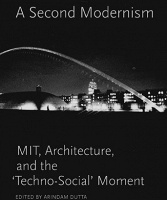
A Second Modernism: MIT, Architecture, and the 'Techno-Social' Moment
MIT List Visual Arts Centre- Date
- 2013
- Publisher
- MIT List Visual Arts Centre
- Format
- Artists' Books
- ISBN
- 978-0262019859
- Size
- 17 × 24.5 × 5 cm
- Length
- 928
Edited by Arindam Dutta.
After World War II, a second modernism emerged in architecture — an attempt, in architectural scholar Joan Ockman’s words, “to transform architecture from a ‘soft’ aesthetic discipline into a ‘hard,’ objectively verifiable field of design expertise.” Architectural thought was influenced by linguistic, behavioral, computational, mediatic, cybernetic, and other urban and behavioral models, as well as systems-based and artificial intelligence theories. This nearly 1,000-page book examines the “techno-social” turn in architecture, taking MIT’s School of Architecture and Planning as its exemplar. In essays and interviews, prominent architectural historians and educators examine the postwar “research-industrial” complex, its attendant cult of expertise, and its influence on Edited by Arindam Dutta.
After World War II, a second modernism emerged in architecture — an attempt, in architectural scholar Joan Ockman’s words, “to transform architecture from a ‘soft’ aesthetic discipline into a ‘hard,’ objectively verifiable field of design expertise.” Architectural thought was influenced by linguistic, behavioral, computational, mediatic, cybernetic, and other urban and behavioral models, as well as systems-based and artificial intelligence theories. This nearly 1,000-page book examines the “techno-social” turn in architecture, taking MIT’s School of Architecture and Planning as its exemplar. In essays and interviews, prominent architectural historians and educators examine the postwar “research-industrial” complex, its attendant cult of expertise, and its influence on life and letters both in America and abroad. Paying particular attention to the ways that technological thought affected the culture of the humanities, the social sciences, and architectural design, the book traces this shift toward complexity as it unfolded, from classroom practices to committee deliberations, from the challenges of research to the vicissitudes of funding. Looking closely at the ways that funded research drew academics towards a “problem-solving” and relevance-seeking mentality and away from the imported Bauhaus model of intuition and aesthetics, the book reveals how linguistics, information sciences, operations research, computer technology, and systems theory became part of architecture’s expanded toolkit. This is a history not just of a school of architecture but of the research-oriented era itself. It offers a thoroughgoing exploration of the ways that policies, politics, and pedagogy transformed themselves in accord with the exponential growth of institutional power.
Related Items



- Art Metropole
- 896 College St
- Toronto, Ontario
- M6H 1A4 Canada
- +1 416 703 4400
- Hours:
- Tuesday to Sunday
- 11AM to 6PM
Art Metropole is a non-profit artist-run centre established 1974 as a division of Art-Official Inc. We are grateful for the support of the Canada Council for the Arts, the Ontario Arts Council, the City of Toronto through the Toronto Arts Council, as well as our donors, members and volunteers.
Your donation assists in the development of contemporary art practices and programs for the general public. Art Metropole is certified by the Ontario Living Wage Network.
- Toronto Arts Council
- Ontario Trillium Foundation
- Canada Council
- Ontario Arts Council
