Shop > Artists' Books
#05778
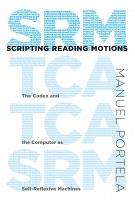
Scripting Reading Motions: The Codex and the Computer as Self-Reflexive Machines
- Artist
- Manuel Portela
- Date
- 2013
- Publisher
- MIT Press
- Format
- Artists' Books
- ISBN
- 9780262019460
- Size
- 15.5 × 23.5 × 3 cm
- Length
- 410
Hardcover with colour cover jacket, 96 b/w illustrations, English text.
In Scripting Reading Motions, Manuel Portela explores the expressive use of book forms and programmable media in experimental works of both print and electronic literature and finds a self-conscious play with the dynamics of reading and writing. Portela examines a series of print and digital works by Johanna Drucker, Mark Z. Danielewski, Rui Torres, Jim Andrews, and others, for the insights they yield about the semiotic and interpretive actions through which readers produce meaning when interacting with codes. Analyzing these works as embodiments and simulations of the motions of reading, Portela pays particular attention to the ways in which awareness of eye movements and haptic interactions in both print and electronic media feeds back onto the material and semantic layers of the works. These feedbacks, he argues, sustain self-reflexive loops that link the body of the reader to the embodied work. Readers’ haptic actions and eye movements coinstantiate the object that they are reading.
Portela discusses typographic and graphic marks as choreographic notations for reading movements; examines digital recreations of experimental print literary artifacts; considers reading motions in kinetic and generated texts; analyzes the relationship of bibliographic, linguistic, and narrative coding in Danielewski’s novel-poem, Only Revolutions; and describes emergent meanings in interactive textual instruments. The expressive use of print and programmable media, Portela shows, offers a powerful model of the semiotic, interpretive, and affective operations embodied in reading processes.
Related Items

- Art Metropole
- 896 College St
- Toronto, Ontario
- M6H 1A4 Canada
- +1 416 703 4400
- Hours:
- Tuesday to Sunday
- 11AM to 6PM
Art Metropole is a non-profit artist-run centre established 1974 as a division of Art-Official Inc. We are grateful for the support of the Canada Council for the Arts, the Ontario Arts Council, the City of Toronto through the Toronto Arts Council, as well as our donors, members and volunteers.
Your donation assists in the development of contemporary art practices and programs for the general public. Art Metropole is certified by the Ontario Living Wage Network.
- Toronto Arts Council
- Ontario Trillium Foundation
- Canada Council
- Ontario Arts Council
