Shop > Monographs
#14855
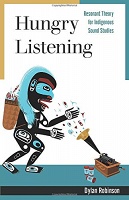
Hungry Listening: Resonant Theory for Indigenous Sound Studies
- Writer
- Dylan Robinson
- Date
- 2020
- Publisher
- University of Minnesota Press
- Format
- Monographs
- ISBN
- 9781517907693
- Size
- 13.9 × 21.5 cm
- Length
- 288 pp
- Genre
- Theory, Indigenous Art & Artists, Sound Art
Hungry Listening considers listening from both Indigenous and settler colonial perspectives. A critical response to what has been called the “whiteness of sound studies,” Dylan Robinson evaluates how decolonial practices of listening emerge from increasing awareness of our listening positionality. This, he argues, involves identifying habits of settler colonial perception and contending with settler colonialism’s “tin ear” that renders silent the epistemic foundations of Indigenous song as history, law, and medicine.
With case studies on Indigenous participation in classical music, musicals, and popular music, Hungry Listening examines structures of inclusion that reinforce Western musical values. Alongside this inquiry on the unmarked terms of inclusion in performing arts organizations and compositional practice, Hungry Listening offers examples of “doing sovereignty” in Indigenous performance art, museum exhibition, and gatherings that support an Indigenous listening resurgence.
Throughout the book, Robinson shows how decolonial and resurgent forms of listening might be affirmed by writing otherwise about musical experience. Through event scores, dialogic improvisation, and forms of poetic response and refusal, he demands a reorientation toward the act of reading as a way of listening. Indigenous relationships to the life of song are here sustained in writing that finds resonance in the intersubjective experience between listener, sound, and space.
Related Items




- Art Metropole
- 896 College St
- Toronto, Ontario
- M6H 1A4 Canada
- +1 416 703 4400
- Hours:
- Tuesday to Sunday
- 11AM to 6PM
Art Metropole is a non-profit artist-run centre established 1974 as a division of Art-Official Inc. We are grateful for the support of the Canada Council for the Arts, the Ontario Arts Council, the City of Toronto through the Toronto Arts Council, as well as our donors, members and volunteers.
Your donation assists in the development of contemporary art practices and programs for the general public. Art Metropole is certified by the Ontario Living Wage Network.
- Toronto Arts Council
- Ontario Trillium Foundation
- Canada Council
- Ontario Arts Council
